Choosing the right height adjustable desk frame involves more than comparing prices. The number of lifting stages affects the frame’s height range, retracted height, and suitability for different users and workstation designs. For furniture manufacturers, office furniture brands, and project buyers, understanding these differences helps balance ergonomic requirements, structural performance, and product costs.
A 2-stage height adjustable desk frame is often suitable for standard workstations with moderate adjustment requirements, while a 3-stage frame can offer a wider adjustment range and a lower minimum height. However, the best choice depends on the complete frame configuration, lifting capacity, motor system, and intended application.
A 2-stage height adjustable desk frame uses telescopic lifting columns with two nested sections. As the desk moves up or down, these sections slide relative to each other to adjust the working height. Its relatively simple construction makes it a practical option for home offices, standard corporate workstations, and cost-conscious furniture projects.
A 2-stage frame can provide reliable sitting-to-standing adjustment when its minimum and maximum heights match the intended users. Buyers should also consider the desktop dimensions, total equipment weight, and required lifting performance rather than assuming that fewer stages mean lower overall quality.
A 3-stage height adjustable desk frame uses three telescopic column sections to provide a longer lifting stroke within a compact column design. This configuration can accommodate a broader height range while maintaining a relatively low minimum desk height, making it suitable for workstations serving users with different heights.
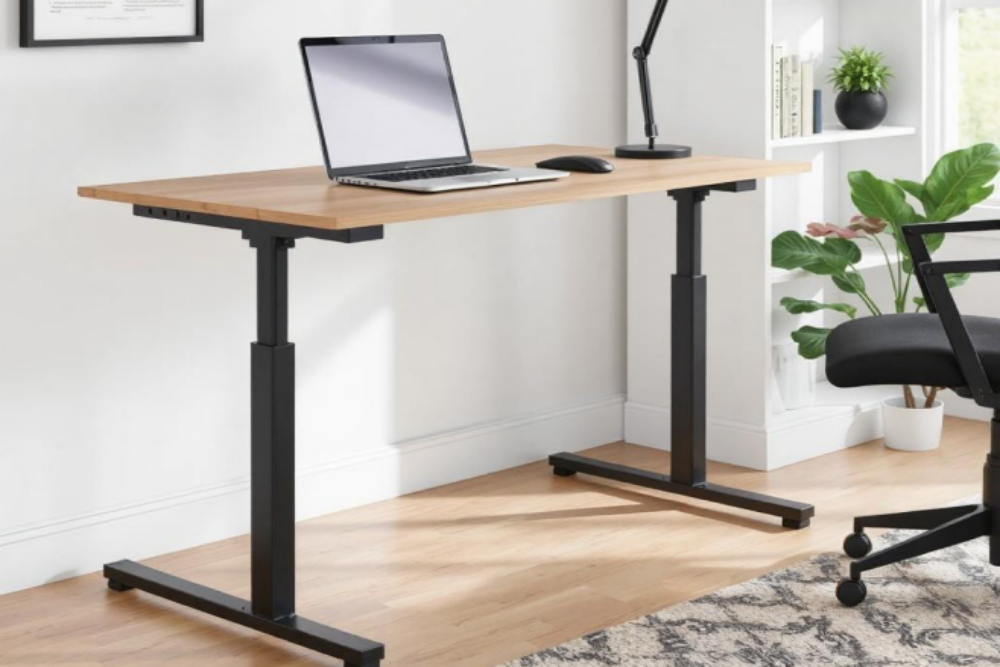
For shared offices, premium standing desks, and OEM furniture projects, a 3-stage frame can provide greater flexibility in workstation design. Nevertheless, the actual adjustment range depends on the column geometry and overall frame configuration, not simply the number of stages.
The minimum desk height is particularly important for seated work, while the maximum height determines whether users can work comfortably while standing. A 2-stage frame may have a higher retracted height, whereas a well-designed 3-stage frame can offer a lower starting position and a longer lifting stroke.
For example, DEWERT OKIN lists its 2-stage 8050 frame with a minimum height of 690 mm, a maximum height of 1,190 mm, and a 500 mm stroke. Its 3-stage 8050 frame has a minimum height of 600 mm, a maximum height of 1,250 mm, and a 650 mm stroke. These product specifications illustrate how different frame configurations can meet different ergonomic requirements. Actual dimensions should always be checked against the selected model.
Lifting stroke refers to the vertical distance the desk can travel between its lowest and highest positions. A longer stroke can make a workstation suitable for a wider range of user heights, especially when both seated and standing positions must be accommodated.
However, buyers should not select a frame based on stroke alone. The required seated height depends on factors such as chair adjustment, leg clearance, desktop thickness, and user posture. The standing height must also provide a comfortable elbow position. Checking the complete desk height range is therefore more useful than comparing stroke length in isolation.
A common misconception is that a 3-stage height adjustable desk frame is automatically more stable than a 2-stage model. In practice, stability depends on column design, steel profile dimensions, frame geometry, structural connections, load distribution, and performance at maximum extension.
Load capacity is equally important. Buyers should verify whether the specified rating refers to the complete frame, each lifting column, or another defined configuration. They should also distinguish static load capacity from performance during repeated lifting.
For dual-motor systems, synchronized movement is an important consideration. Motor coordination, control electronics, and mechanical tolerances can affect smoothness and help prevent uneven lifting. Buyers should review the manufacturer's performance data and testing conditions before comparing competing products.
A 2-stage frame may be a more economical option when a standard adjustment range meets the application requirements. A 3-stage frame may justify a higher project cost when a wider height range, lower minimum height, or greater design flexibility is necessary.
The total cost also depends on motor configuration, control systems, lifting capacity, frame width, accessories, and order volume. OEM buyers should compare complete configurations rather than evaluating the number of lifting stages as an isolated cost factor.
For a home office or a conventional single-user workstation, a 2-stage frame can be sufficient when its adjustment range fits the user and desktop design. Buyers should prioritize a suitable minimum height, adequate load capacity, smooth movement, and compatibility with the desktop.
A 3-stage model becomes more attractive when the desk must accommodate a broader range of user heights or provide more flexibility for future furniture configurations.
Commercial offices often serve multiple users with different ergonomic requirements. A 3-stage height adjustable desk frame can provide additional flexibility for shared workstations, particularly when users frequently alternate between sitting and standing.
For large office projects, buyers should also consider duty cycle, operating noise, control functions, cable management, and long-term service requirements. These factors can have a greater effect on the user experience than the lifting-stage count alone.
For premium office furniture brands and OEM manufacturers, a 3-stage frame can support more flexible product positioning and workstation design. Adjustable frame width, lifting performance, and compatibility with different desktop sizes are important when developing several desk models around a common frame platform.
Project buyers should confirm the required specifications early in product development. This helps avoid redesigns caused by insufficient height adjustment, unsuitable frame width, excessive desktop loading, or incompatible control components.
Confirm the complete assembled desk height, including desktop thickness where relevant. Check whether the lowest position supports comfortable seated work and whether the highest position suits the tallest intended user.
For projects serving multiple user groups, evaluate the full adjustment range instead of relying on a typical office desk height.
Check the frame's adjustable width against the desktop dimensions and mounting points. A frame that is too narrow or too wide may not provide the intended support or fit the furniture design.
Calculate the combined load of the desktop, monitors, computer equipment, and other accessories. Confirm the rated capacity and applicable test conditions with the supplier. For larger workstations, also evaluate lateral movement and stability at maximum extension.
Motor configuration affects how lifting force is delivered and controlled. A dual-motor system can distribute the lifting task between two columns, but its actual performance depends on motor output, synchronization, control electronics, and the mechanical design.
Lifting speed is another practical consideration. Faster adjustment can improve convenience in shared workspaces, while smooth motion and operating noise may be especially important in offices and meeting rooms.
Before ordering, confirm the power supply, handset functions, memory presets, anti-collision options if required, and compatibility with the intended control system. Buyers should also request model-specific information about installation, maintenance, and operating limits.
A 3-stage dual-motor height adjustable desk frame is worth considering when a project requires a wider adjustment range, a lower minimum height, or support for larger workstation configurations. The three-stage telescopic columns provide greater travel potential, while the dual-motor configuration can deliver coordinated lifting across the frame.
DEWERT OKIN's 8050 3-stage height adjustable desk frame is one example. According to the manufacturer's product page, the model offers a 600–1,250 mm height range, a 650 mm lifting stroke, a maximum lifting speed of 35 mm/s, a listed load capacity of 1,200 N, and an adjustable frame width of 1,100–1,800 mm. Its three-part lifting columns and adjustable frame width make it a relevant option for projects requiring flexible workstation dimensions.
For applications involving wider desktops, DEWERT OKIN also lists the 8050 DS8-3 Stage configuration with an adjustable frame width of 1,406–3,026 mm. Buyers developing larger or multi-user workstations should review this configuration separately and confirm its load rating and installation requirements for the intended application.
These product examples demonstrate why frame selection should be based on verified technical specifications rather than stage count alone. For OEM projects, it is advisable to confirm the complete configuration with DEWERT OKIN before finalizing the furniture design.